Libraries & Data
Let's start by loading a few libraries and create a simple dataset:
import pandas as pd
import matplotlib.pyplot as plt

df = pd.DataFrame(
    {
        "x": range(1, 6),
        "y1": [10, 4, 6, 5, 3],
        "y2": [12, 2, 7, 10, 1],
        "y3": [8, 18, 5, 7, 6],
    }
)
df.head()| x | y1 | y2 | y3 | |
|---|---|---|---|---|
| 0 | 1 | 10 | 12 | 8 |
| 1 | 2 | 4 | 2 | 18 |
| 2 | 3 | 6 | 7 | 5 |
| 3 | 4 | 5 | 10 | 7 |
| 4 | 5 | 3 | 1 | 6 |
Basic color customization
The easiest way to customize the colors of your chart is to pass to the colors argument a list of colors:
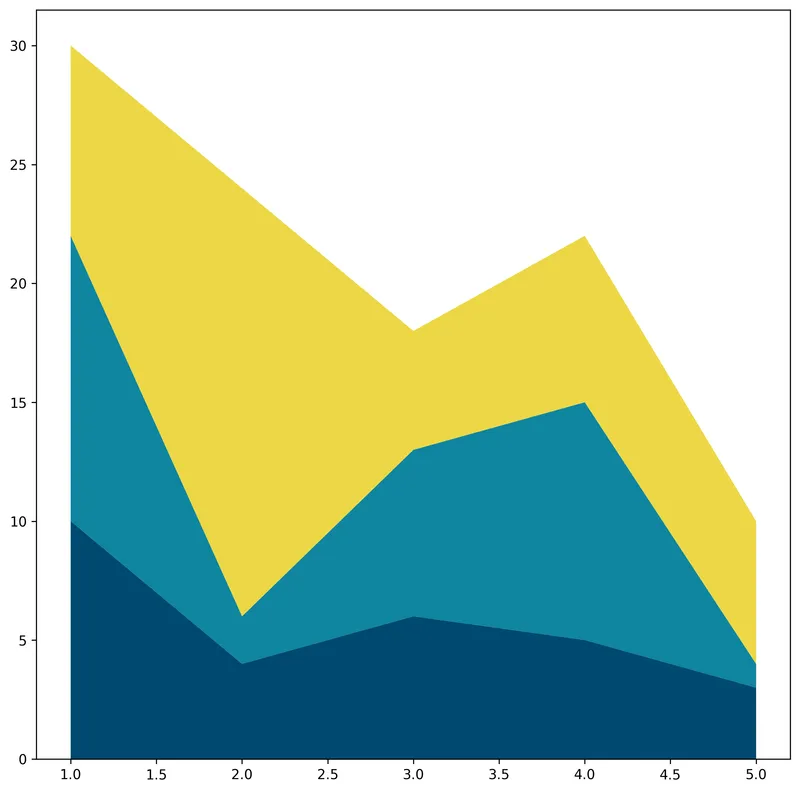
fig, ax = plt.subplots(figsize=(10, 10), dpi=300)

ax.stackplot(
    df["x"],
    df["y1"],
    df["y2"],
    df["y3"],
    colors=["#00496FFF", "#0F85A0FF", "#EDD746FF"],
)

plt.show()Linewidth style
The edgecolor argument sets the color of the area borders, while linewidth determines how thick those borders are.
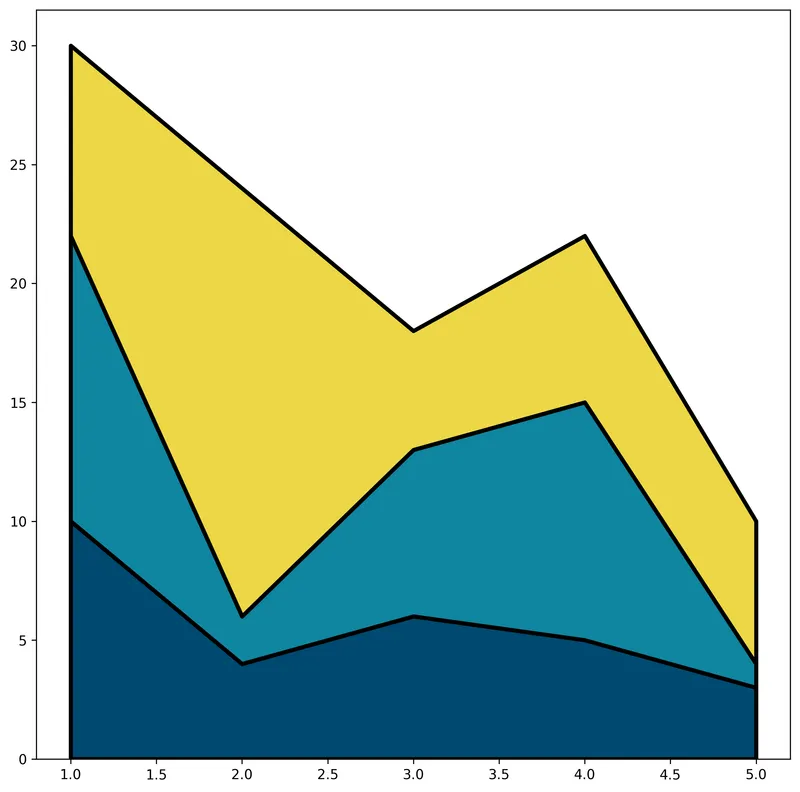
fig, ax = plt.subplots(figsize=(10, 10), dpi=300)

ax.stackplot(
    df["x"],
    df["y1"],
    df["y2"],
    df["y3"],
    edgecolor="black",
    linewidth=3,
    colors=["#00496FFF", "#0F85A0FF", "#EDD746FF"],
)

plt.show()Opacity
We can easily change the opacity of the chart thanks to the alpha argument. Possible values range from 0 (completely transparent) to 1 (completely opaque), and the default one is 1:
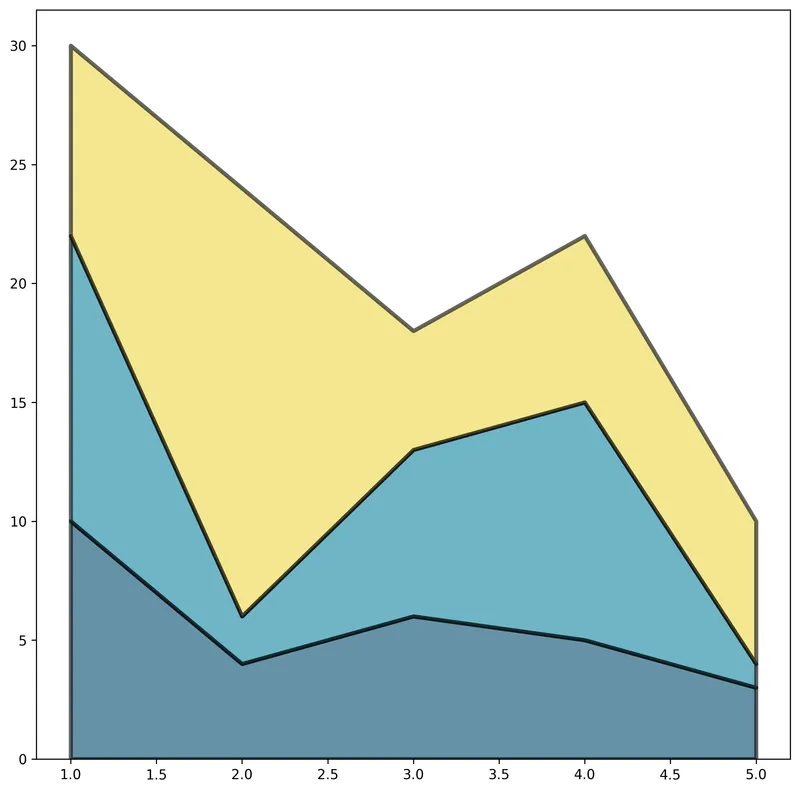
fig, ax = plt.subplots(figsize=(10, 10), dpi=300)

ax.stackplot(
    df["x"],
    df["y1"],
    df["y2"],
    df["y3"],
    edgecolor="black",
    linewidth=3,
    alpha=0.6,
    colors=["#00496FFF", "#0F85A0FF", "#EDD746FF"],
)

plt.show()Pattern inside the areas
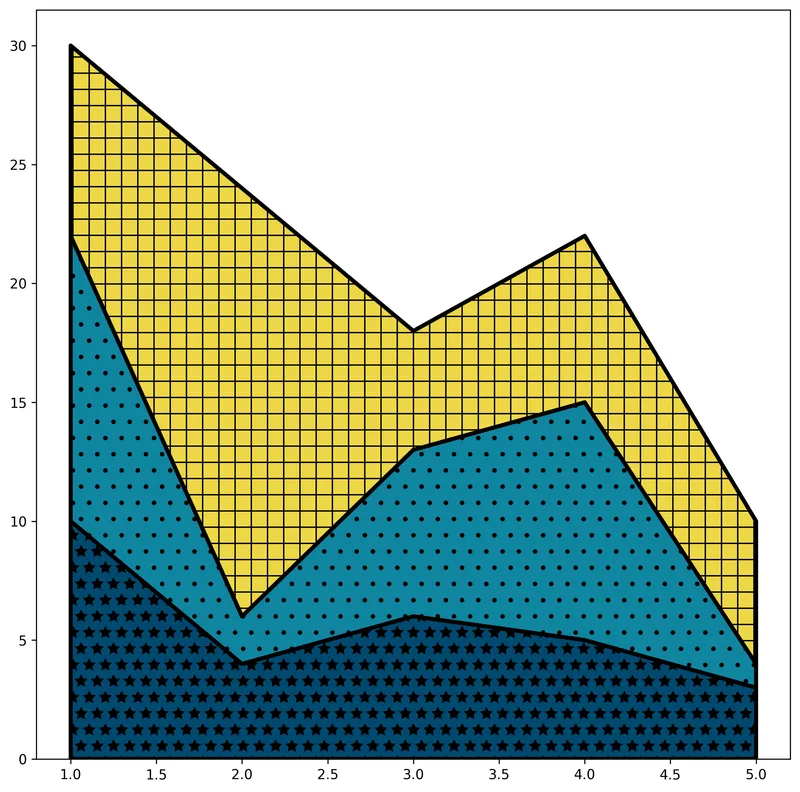
fig, ax = plt.subplots(figsize=(10, 10), dpi=300)

ax.stackplot(
    df["x"],
    df["y1"],
    df["y2"],
    df["y3"],
    edgecolor="black",
    linewidth=3,
    colors=["#00496FFF", "#0F85A0FF", "#EDD746FF"],
    hatch=["*", ".", "+"],
)

plt.show()More colors with PyPalettes
Thanks to the pypalettes library, it's super easy to use a large number of palette in your seaborn/matplotlib charts. You can find your dream palette in the color palette finder, and use the load_cmap() function with the name of the palette you want and then access the colors attribute. Here is an example with the Acadia palette:
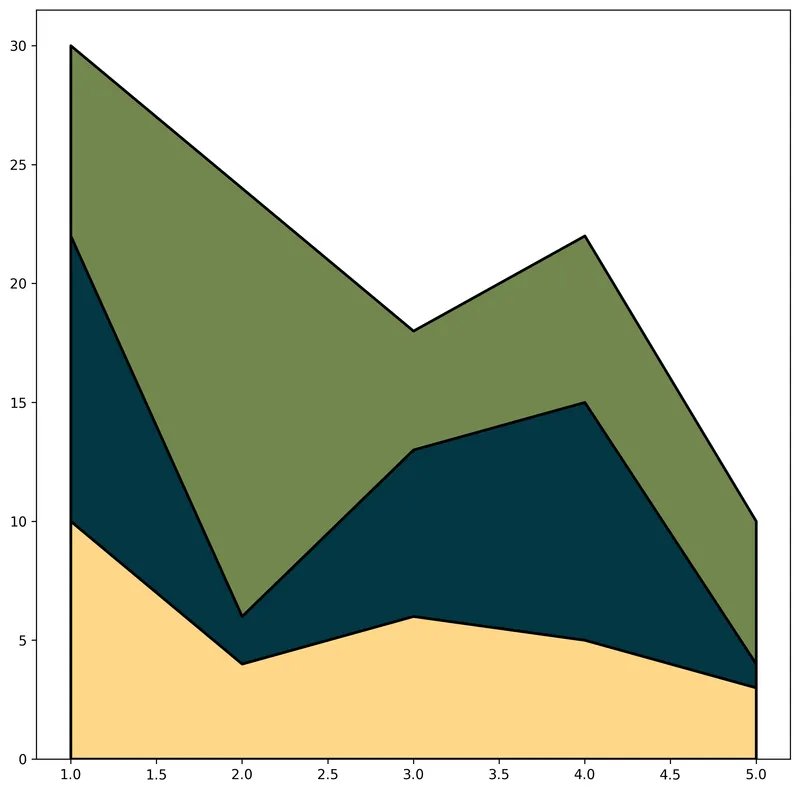
from pypalettes import load_palette

colors = load_palette("Acadia")

fig, ax = plt.subplots(figsize=(10, 10), dpi=300)

ax.stackplot(
    df["x"], df["y1"], df["y2"], df["y3"], edgecolor="black", linewidth=2, colors=colors
)

plt.show()Going further
You might be interested in:
- what are the other options when building a staked area chart?
- how to smooth a stacked area chart
- how to create a small multiple area chart