Most basic
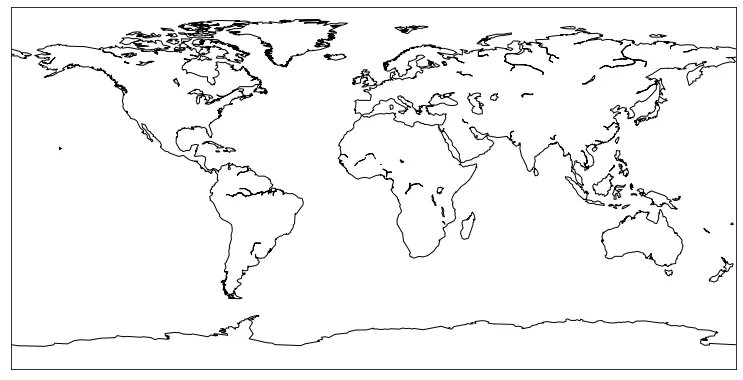
Building a map with the basemap library always follow the same process. Once the library is loaded, a map is initialized with the Basemap() function. Then, some part of the maps a drawn. For instance, coastlines can be added with the drawcoastlines() function:
# libraries
from mpl_toolkits.basemap import Basemap
import numpy as np
import matplotlib.pyplot as plt

# Set the plot size for this notebook:
plt.rcParams["figure.figsize"]=13,13

# Always start witht the basemap function to initialize a map
m=Basemap()

# Show the coast lines
m.drawcoastlines()

plt.show();Bounding
You can select a specific area of the world when you initialize the map with the Basemap() function. Let's say you want to draw south america:
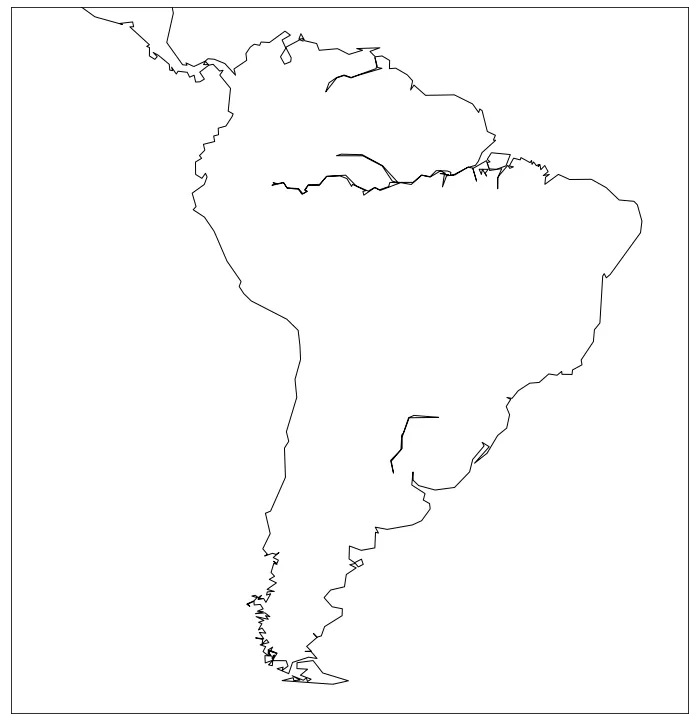
m=Basemap(llcrnrlon=-100, llcrnrlat=-58,urcrnrlon=-30,urcrnrlat=15)

# Show the coast lines
m.drawcoastlines()

plt.show()Colors
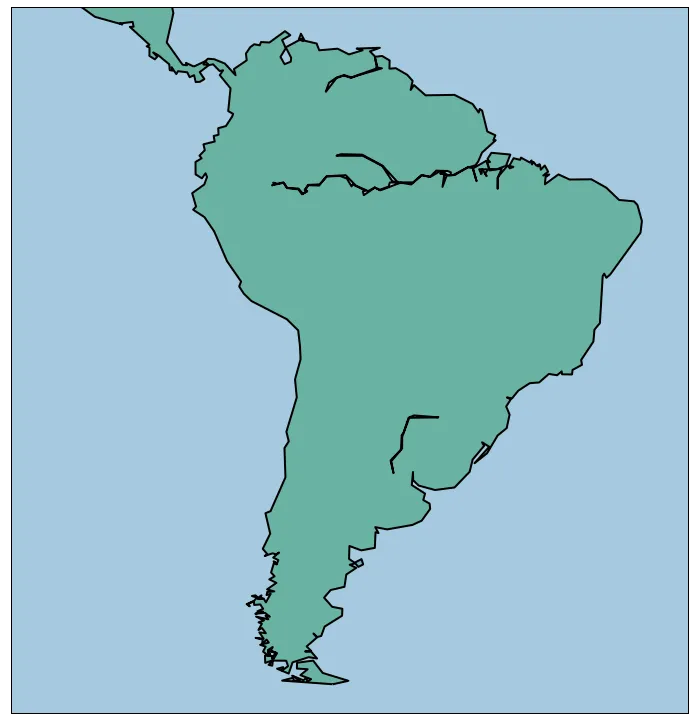
You probably want to have something better than this black and white map. For each function adding boundaries, you can specify some parameter for color, width and so on:
# Initialize
m=Basemap(llcrnrlon=-100, llcrnrlat=-58,urcrnrlon=-30,urcrnrlat=15)

# Background color:
m.drawmapboundary(fill_color='#A6CAE0')

# Continent in green
m.fillcontinents(color='#69b2a2',lake_color='#A6CAE0')

# Show the coast lines in black
m.drawcoastlines(color='black', linewidth=2)

plt.show()List of available boundaries
Several types of boundaries are available in functions similar to drawcoastlines(). Country boundaries are available with drawmapboundary(), continents with fillcontinents(), rivers with drawrivers(), US counties with drawcounties() and US states with drawstates()
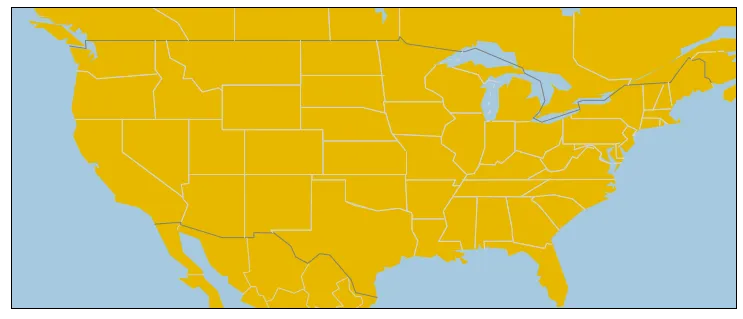
Let's make the best of it with a map of the US
# initialise
map = Basemap(llcrnrlon=-130, llcrnrlat=25, urcrnrlon=-65.,urcrnrlat=52., lat_0 = 40., lon_0 = -80)

# background color
map.drawmapboundary(fill_color='#A6CAE0', color="black")

# country color
map.fillcontinents(color='#e6b800',lake_color='#A6CAE0')
map.drawcountries(color='grey', linewidth=1)

# Show states
map.drawstates(color='lightgrey', linewidth=1)

plt.show()Projection
Several projections are offered by the basemap library. You just have to specify it in the projection parameter of the Basemap() function. Let's have a look to the possibilities:
ortho
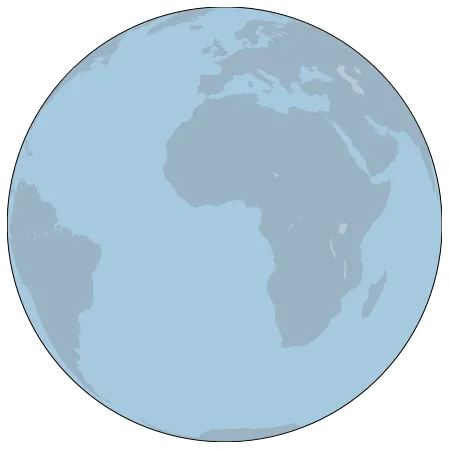
# ortho
plt.rcParams["figure.figsize"]=8,8
m=Basemap(lat_0=0, lon_0=0, projection='ortho' )
m.drawmapboundary(fill_color='#A6CAE0')
m.fillcontinents(color='grey', alpha=0.3)
plt.show();merc
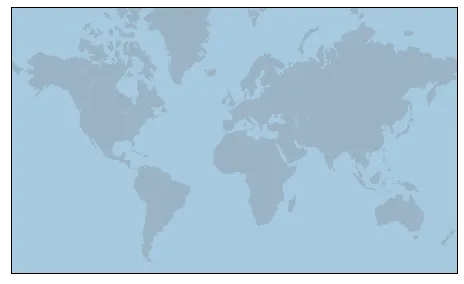
# merc
m=Basemap(llcrnrlon=-180, llcrnrlat=-60,urcrnrlon=180,urcrnrlat=80, projection='merc')
m.drawmapboundary(fill_color='#A6CAE0')
m.fillcontinents(color='grey', alpha=0.3)
plt.show()robin
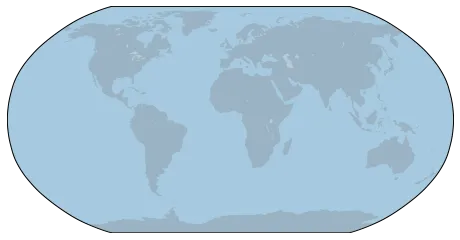
# robin
m=Basemap(lat_0=0, lon_0=0, projection='robin' )
m.drawmapboundary(fill_color='#A6CAE0')
m.fillcontinents(color='grey', alpha=0.3)
plt.show()aeqd
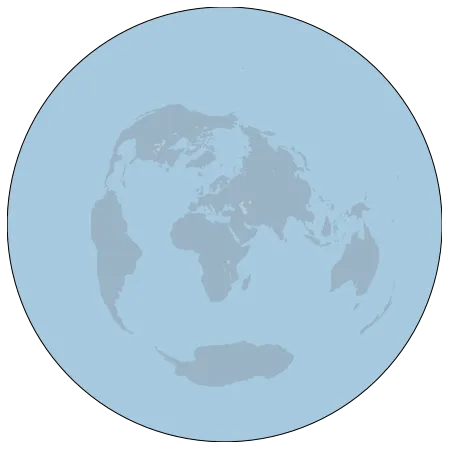
#aeqd --> you HAVE to provide lon_0 and lat_0
m=Basemap(lat_0=30, lon_0=30, projection='aeqd' )
m.drawmapboundary(fill_color='#A6CAE0')
m.fillcontinents(color='grey', alpha=0.3)
plt.show()nsper
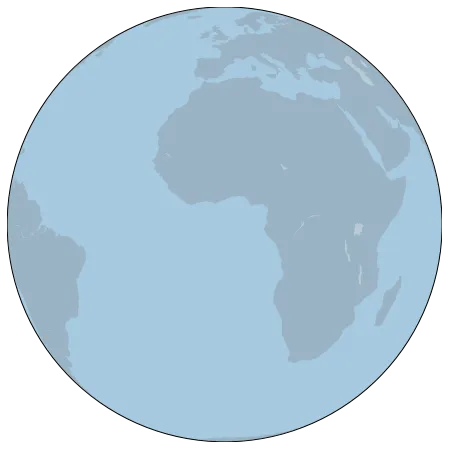
#nsper
m=Basemap(lat_0=0, lon_0=0, projection='nsper' )
m.drawmapboundary(fill_color='#A6CAE0')
m.fillcontinents(color='grey', alpha=0.3)
plt.show()cyl
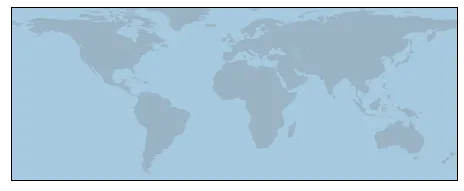
#cyl
m=Basemap(llcrnrlon=-180, llcrnrlat=-60,urcrnrlon=180,urcrnrlat=80, projection='cyl' )
m.drawmapboundary(fill_color='#A6CAE0')
m.fillcontinents(color='grey', alpha=0.3)
plt.show()Background Layer
Last but not least, you can load a background layer for the map. Instead of showing some boundaries and uniform colors only, it will show some nice backgrounds. Several options are available:
bluemarble
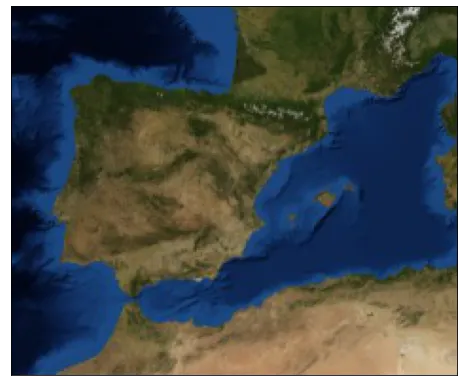
m = Basemap(llcrnrlon=-10.5,llcrnrlat=33,urcrnrlon=10.,urcrnrlat=46., resolution='i', projection='cass', lat_0 = 39.5, lon_0 = 0.)
m.bluemarble()
plt.showshadedrelief
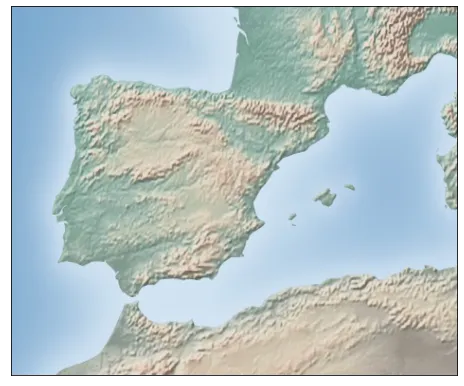
m = Basemap(llcrnrlon=-10.5,llcrnrlat=33,urcrnrlon=10.,urcrnrlat=46., resolution='i', projection='cass', lat_0 = 39.5, lon_0 = 0.)
m.shadedrelief()
plt.show()ArcGis
I looks like arcGis background requires some sort of authentification now 🤔. The code below looks outdated
# World Shaded Relief
# m = Basemap(projection='mill',llcrnrlon=-123. ,llcrnrlat=37,urcrnrlon=-121 ,urcrnrlat=39, resolution = 'l', epsg = 4326)
# m.arcgisimage(service='World_Shaded_Relief', xpixels = 1500, verbose= True)

# Ocean Basemap
# m = Basemap(projection='mill',llcrnrlon=-123. ,llcrnrlat=37,urcrnrlon=-121 ,urcrnrlat=39, resolution = 'l', epsg = 4326)
# m.arcgisimage(service='Ocean_Basemap', xpixels = 1500, verbose= True)