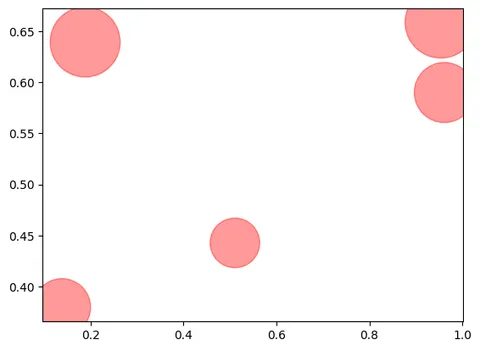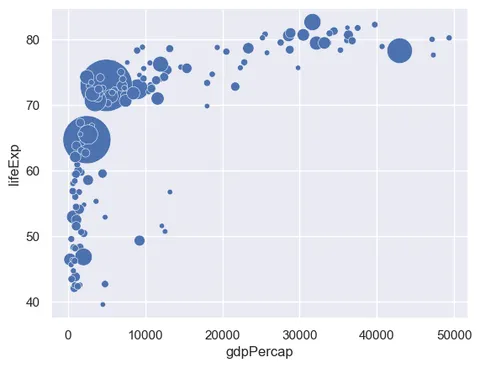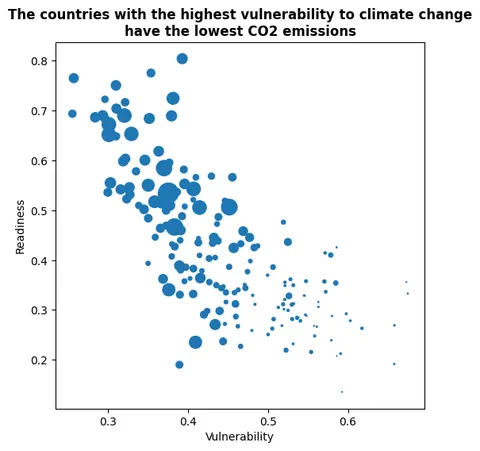
A bubble plot is a scatterplot with a third dimension: the size of the markers. It is even possible to add a fourth dimension using colors. It can be done using the cmap argument of the scatter() function of matplotlib.
Libraries & Dataset
We will start by importing the necessary libraries and loading the dataset.
Since bubble plots requires numerical values, we need to have quantitative data in our dataset.
# libraries
import matplotlib.pyplot as plt
import numpy as np
import pandas as pd

# create data
df = pd.DataFrame({
      'x': np.random.rand(40),
      'y': np.random.rand(40),
      'z': np.random.rand(40),
      'cat': np.random.choice(['A', 'B', 'C'], 40)
   })
df.head()| x | y | z | cat | |
|---|---|---|---|---|
| 0 | 0.581679 | 0.239945 | 0.266493 | A |
| 1 | 0.776207 | 0.734859 | 0.788658 | B |
| 2 | 0.672333 | 0.055408 | 0.865137 | C |
| 3 | 0.151227 | 0.820374 | 0.186279 | A |
| 4 | 0.517176 | 0.403605 | 0.312726 | A |
Map with numerical values
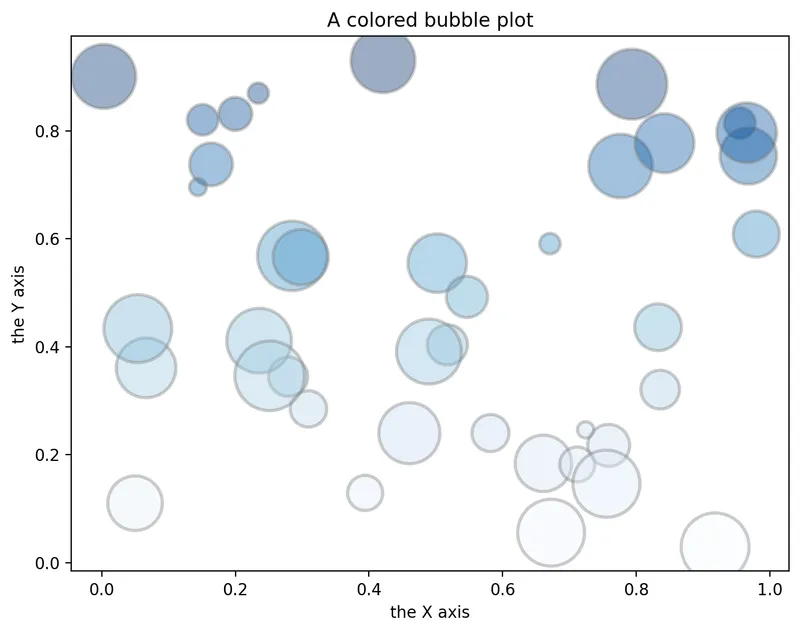
First, we initiate a simple bubble plot using the scatter() function from matplotlib. By incorporating the cmap argument, we introduce a fourth dimension to our plot.
Here, the y variable dictates the color of the markers—observed as progressively darker hues as values ascend on the y-axis.
# Initiate the chart
fig, ax = plt.subplots(figsize=(8,6), dpi=200)

# We map the color to the X axis value.
ax.scatter(
   x=df['x'],
   y=df['y'],
   s=df['z']*2000,
   c=df['y'],
   cmap="Blues",
   alpha=0.4,
   edgecolors="grey",
   linewidth=2
)

# Add titles (main and on axis)
ax.set_xlabel("the X axis")
ax.set_ylabel("the Y axis")
ax.set_title("A colored bubble plot")

# Show the graph
plt.show()Map with categorical values with cmap
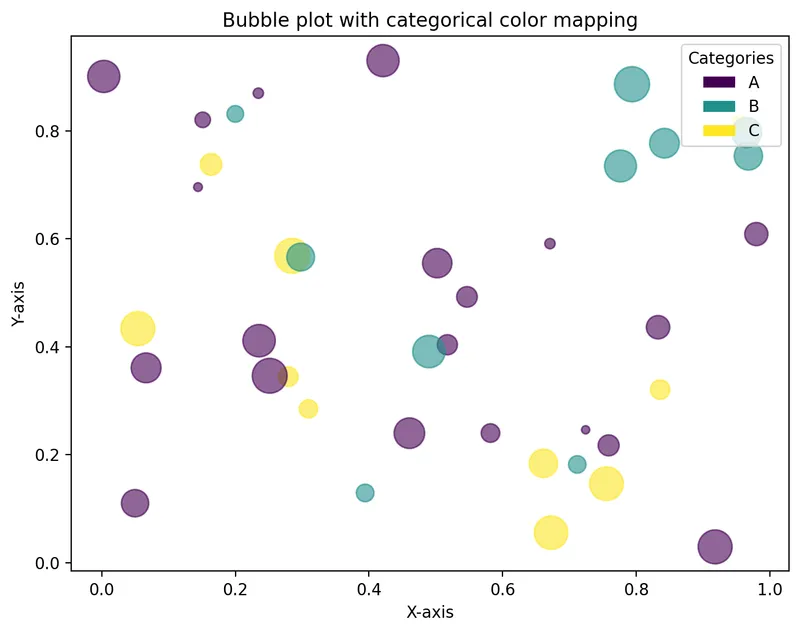
To create a bubble plot with categorical color mapping and a legend in Matplotlib:
-
Encode Categories: Convert category names into numerical codes using
pd.factorize. -
Initialize Chart: Set up the plotting area using
fig, ax = plt.subplots. -
Create Bubble Plot: Plot the data points using
ax.scatter. Thexandyparameters determine the position of the bubbles,scontrols their size, andcsets their color based on category codes.cmapdefines the color map, andalphasets the transparency. -
Add Legend:
- Import
Patchfrommatplotlib.patches. - Create legend handles by iterating over the unique category names and their corresponding codes. Each handle is a
Patchobject with the color from the scatter plot's colormap. - Add the legend to the plot with
ax.legend, setting the handles, title, and location.
- Import
-
Customize Axes and Display: Label the axes and title, then show the plot with
plt.show().
# Encode the categories as integers
category_codes, category_names = pd.factorize(df['cat'])

# Initiate the chart
fig, ax = plt.subplots(figsize=(8,6), dpi=200)

# Create the bubble plot
scatter = ax.scatter(
   x=df['x'],
   y=df['y'],
   s=df['z']*500,
   c=category_codes,
   cmap='viridis',
   alpha=0.6
)

# Legend
from matplotlib.patches import Patch
handles = [Patch(facecolor=scatter.cmap(scatter.norm(i)), label=label)
           for i, label in enumerate(category_names)]
ax.legend(handles=handles, title='Categories', loc='upper right')

# Custom axes and display chart
ax.set_xlabel('X-axis')
ax.set_ylabel('Y-axis')
ax.set_title('Bubble plot with categorical color mapping')
plt.show()Map with categorical values with specific colors
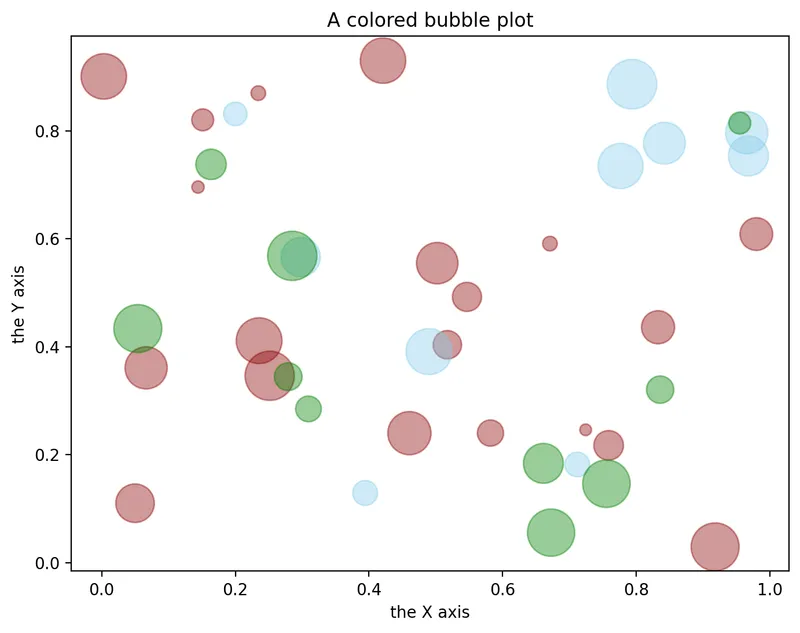
If you want to use your own colors for the categories, you can create a dictionary that maps category names to colors. Then, you can pass the colors to the c parameter of the scatter() function.
However, there is no know method for avoiding the for loop when creating the scatter plot.
# Initiate the chart
fig, ax = plt.subplots(figsize=(8,6), dpi=200)

# Define color mapping
colors = {'A':'darkred', 'B':'skyblue', 'C':'green'}

# Iterate over each group value
for group, color in colors.items():
    ax.scatter(
        x=df['x'][df['cat']==group],
        y=df['y'][df['cat']==group],
        s=df['z'][df['cat']==group]*1000,
        c=color,
        alpha=0.4
    )

# Add titles (main and on axis)
ax.set_xlabel("the X axis")
ax.set_ylabel("the Y axis")
plt.title("A colored bubble plot")

# Show the graph
plt.show()Going further
You might be interested in:
- how to change colors, shape and size of the bubbles
- how to create a beautiful bubble plot in python